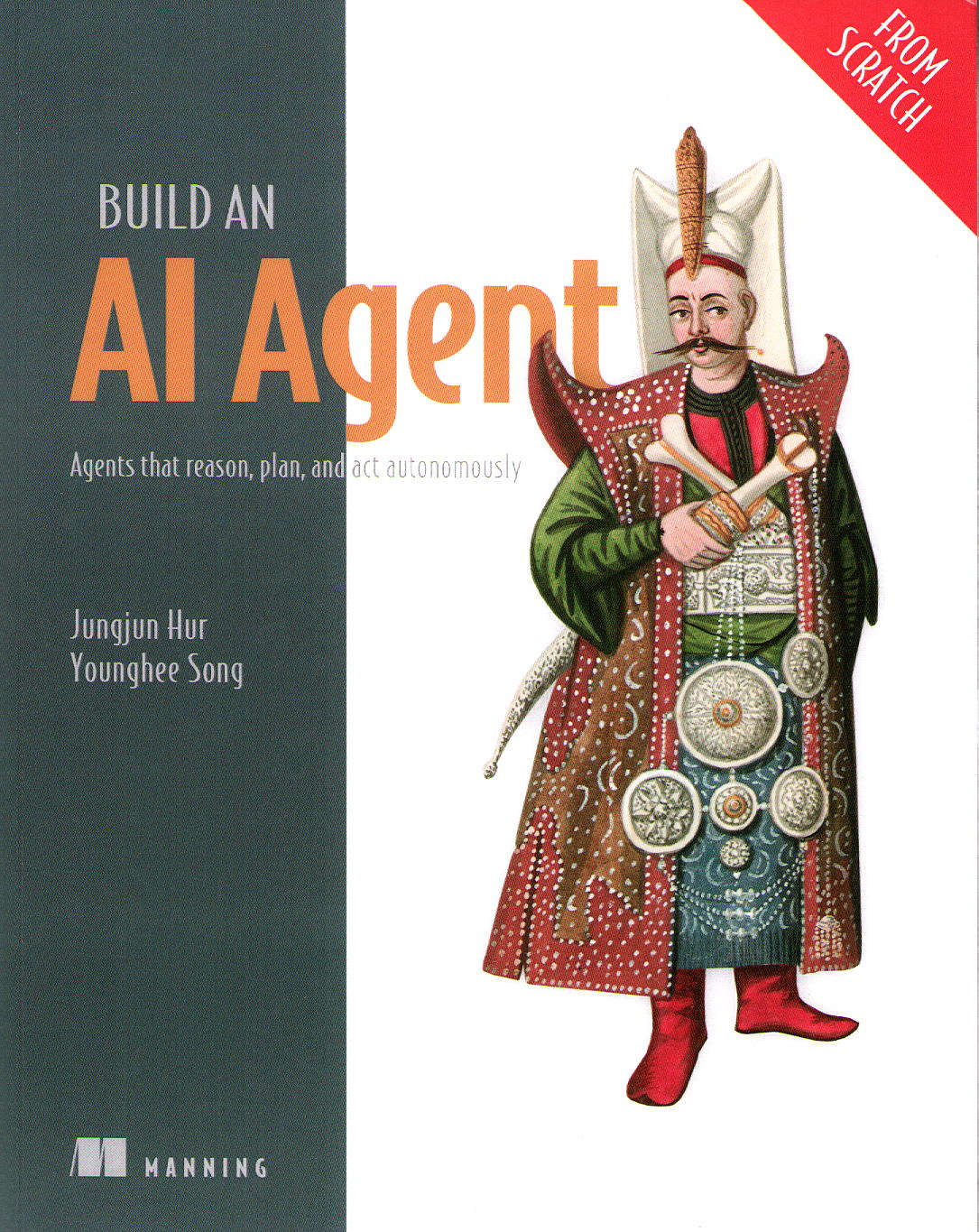
 | | 系統號碼 | 1004111 | | 書刊名 | Build an AI agent (from scratch) : agents that reason, plan, and act autonomously / | | 主要著者 | Jungjun Hur ; Younghee Song. | | 其他著者 | Hur, Jungjun,;Song, Younghee, | | 出版項 | Shelter Island, NY : Manning Publicatios Co., [2026];Shelter Island, NY : Manning Publicatios Co., ©2026 | | 索書號 | Q335.H87 2026 | | ISBN | 9781633434615 | | 標題 | Intelligent agents (Computer software)
Artificial intelligence-Business applications.
Multiagent systems.
Generative artificial intelligence.
Artificial intelligence.
Handbooks and manuals.-lcgft | | | |
|
|
 |
| | 資料類型 | 狀態 | 應還日期 | 預約人數 | 館藏地 | 索書號 | 條碼號 | | 找書 | 圖書 | 在架上 | | 0 | 總館
西文圖書區  | Q335 .H87 2026 | W116401 |
| 內容簡介 | Build an AI Agent (From Scratch) is a fascinating step-by-step journey through design, development, and deployment of a system of autonomous AI agents. Authors Jungjun Hur and Younghee Song guide you concept by concept as you build a sophisticated research agent in Python, designed to solve complex, multi-step tasks from the rigorous GAIA (General AI Assistants) benchmark. By seeing the construction of the system end to end, you’ll understand how the underlying mechanics are unobstructed by any existing blackbox libraries and frameworks. This book includes ten meaty chapters and a handy appendix (about how to get an OpenAI API key). The technical explanations throughout the book are made crystal clear by the use of many helpful diagrams. As one reviewer remarked, even for someone building their first agent, “nothing feels like magic or a mystery after the first few chapters!” Early on, you’ll establish the foundational blueprint for your agent by distinguishing rigid developer-defined workflows from true, LLM-directed agent loops. You’ll learn how to manage stateless APIs, enforce structured outputs using Pydantic, and implement dynamic tool-calling. Crucially, the book centers on “Context Engineering”—the discipline of systematically structuring information to prevent context rot and the “Lost in the Middle” effect. One technical reviewer particularly appreciated that core concepts like agent loops, context engineering, and evaluation are introduced with clear motivation and practical examples rather than as isolated abstractions. After you build the basic agent, you’ll progressively expand its capabilities by integrating custom web search, local file system exploration, and vector-based RAG to navigate complex data. You’ll also enable the agent to recall past failures and adapt state persistence through hierarchical context optimization and longterm memory. Along the way, you’ll see how to use the Model Context P |
讀者書評 |
尚無書評,
|
|